
San Diego, CA: April 17–22, 2026 — Altis Labs, Inc. ("Altis") is announcing results presented at the American Association for Cancer Research (AACR) Annual Meeting 2026 evaluating the prognostic utility of Imaging-based Prognostication (IPRO-α), an AI-derived score from pretreatment CT imaging, in patients with stage IV colorectal cancer (CRC) receiving first-line (1L) systemic therapy.
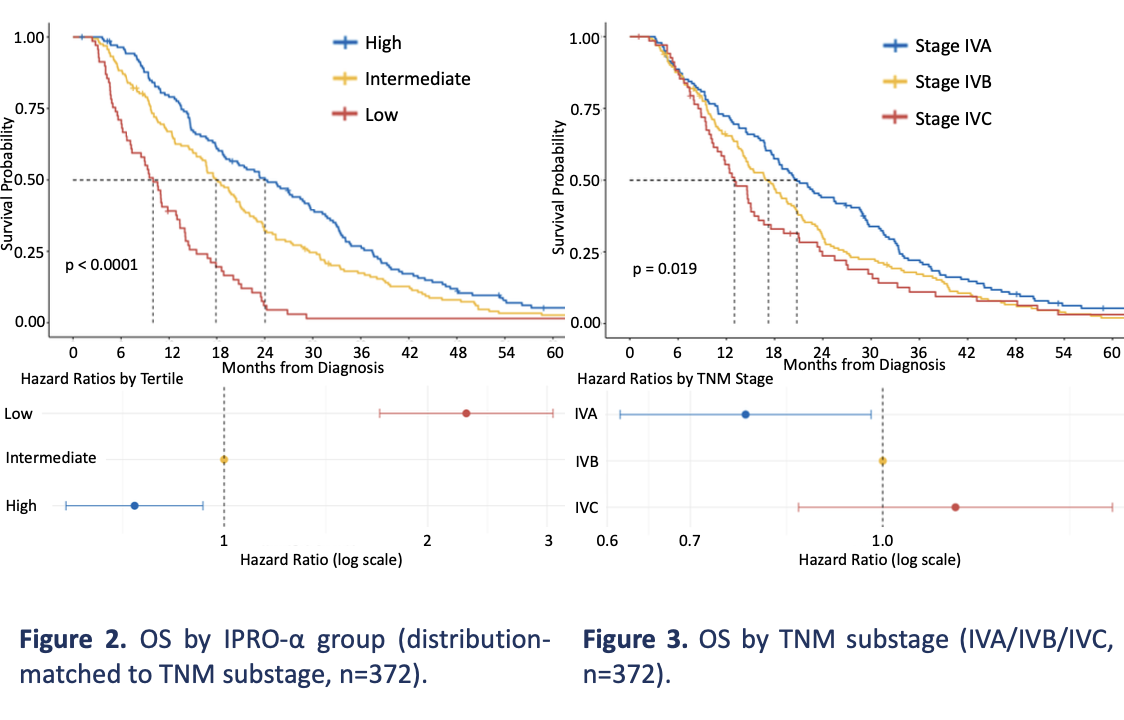
The study retrospectively evaluated IPRO-α and stage IV TNM substage in an external real-world cohort of 372 stage IV CRC patients treated with 1L systemic therapy between 2010–2018 across 17 cancer centers. The median age was 61 years (IQR 52–69), and 32.8% of patients (n=122) were female. Pre-treatment CT scans were processed automatically to generate numeric IPRO-α scores, which quantify imaging biomarkers spanning tumor burden, body composition (skeletal muscle, fat), and cardiovascular features. Patients were stratified into three distribution-matched groups (High/Intermediate/Low) for comparison against TNM substage (IVA/IVB/IVC). Median overall survival (mOS) and hazard ratios (HRs) were estimated using Cox proportional hazards models.
Key findings:
Notably, IPRO-α was trained exclusively on advanced non-small cell lung cancer (aNSCLC) data, making its performance in CRC an out-of-distribution generalization. These results confirm that IPRO-α has learned prognostic imaging features applicable across tumour types, and suggest that AI can capture additional prognostic information from CT imaging beyond TNM staging. Future work will assess the performance of IPRO trained on CRC-specific data, in larger sample sizes, and in populations treated with different treatment modalities.
View the abstract here.
About Altis Labs
Altis Labs is the computational imaging company accelerating clinical trials with AI. Altis has trained proprietary AI models on the industry's largest multimodal training database spanning over 200 million longitudinal images linked to clinical, molecular, treatment, and outcomes data. Top 20 biopharmas use Altis' AI models to more confidently analyze data from phase 1–4 clinical trials and bring the most effective novel treatments to patients sooner. For more information, visit www.altislabs.com, follow @AltisLabs on social media, or email info@altislabs.com.