
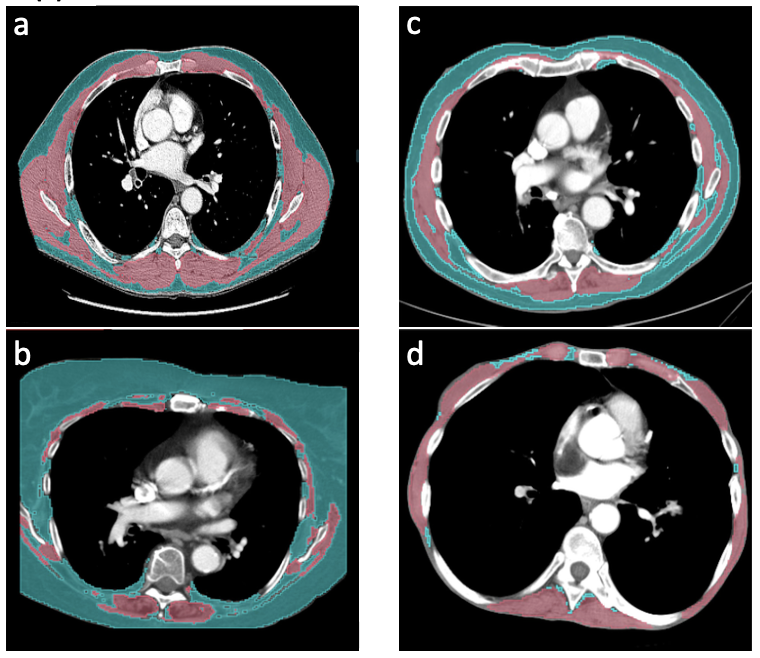
Berlin, Germany: October 17–21, 2025 — Altis Labs, Inc. (“Altis”) is announcing results presented at the European Society for Medical Oncology (ESMO) Congress 2025 evaluating the prognostic associations of longitudinal changes in skeletal muscle volume (SMV) and subcutaneous fat volume (SFV) using AI-based body composition quantification in patients with advanced non–small cell lung cancer (aNSCLC). The analysis examined whether percent change from baseline (%CFB) in these features was associated with overall survival (OS).
The study included 802 aNSCLC patients (415 female, 387 male) treated with first-line systemic therapy across 17 Canadian cancer centers, with baseline and follow-up CT scans available at 8 ± 4 weeks after treatment initiation. SMV and SFV were extracted from segmentation masks based on a 3D U-net architecture, and SMV-%CFB and SFV-%CFB were divided into quartiles, with Q4 representing the highest-risk group (greatest loss). Kaplan–Meier and Cox proportional hazards analyses assessed associations with median OS (mOS).
Capturing post-treatment changes in SMV and SFV with AI-based tools may have prognostic value in aNSCLC. The results also highlight sex-specific differences in these associations, underscoring the need for individualized and targeted prognostic tools.
Altis Labs is the computational imaging company accelerating clinical trials with AI. Altis has trained proprietary AI models on the industry's largest multimodal training database spanning over 200 million longitudinal images linked to clinical, molecular, treatment, and outcomes data. Top 20 biopharmas use Altis’ AI models to more confidently analyze data from phase 1-4 clinical trials and bring the most effective novel treatments to patients sooner.For more information, visit www.altislabs.com, follow @AltisLabs on social media, or email info@altislabs.com.
Presented at ESMO Congress 2025, Berlin, Germany.
Poster #1868P.